Back to our conference:
Opportunities and prospects for energy transition in Estonia
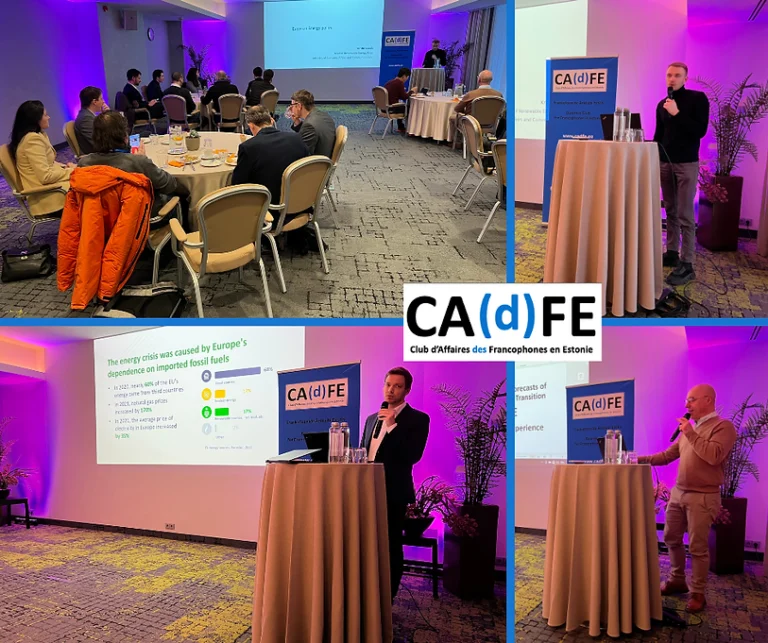
Last Thursday, we held our conference on the theme of energy transition in Estonia, at which our speakers, professionals from the sector, shared their visions and forecasts for the development of the energy market in the region.
Our members also had the opportunity to ask questions and discuss future issues.
The conference began with an introductory speech by our President, followed by our first speaker, Kristo Kaasik, Director of the Renewable Energy Sector at Estonia’s Ministry of Economic Affairs and Communications.
Kristo Kaasik began his speech by taking stock of Estonia’s progress towards its targets for renewable energy production and consumption, in comparison with other European countries.
Estonia is the 8th European country with the highest share of renewable energy in its production (30.2% in 2020).
Nevertheless, Estonia has real difficulties in producing low-cost energy, which penalizes it and makes it less competitive on this market.
In any case, the country is not lacking in ambition, since the government’s stated goal is for 100% of the energy produced in Estonia to be renewable by 2030.
Kristo Kaasik also gave us an overview of the resources and infrastructure being deployed to achieve these targets, via solar and especially wind power projects.
This also involves changes in legislation to speed up the launch of these projects and achieve these targets on time.
In this way, Estonia also hopes to gain energy independence.
Then it was the turn of Raido Hallik, Director of Services and Renewable Energy Development at Enefit Green.
Raido Hallik began by pointing out that the current energy crisis has highlighted the extent of the EU’s dependence on fossil fuels.
Enefit Green’s ambition is to become the largest producer of renewable energy in the Baltic States and a major player in this sector in Poland.
Enefit Green currently relies on long-term energy sales contracts to invest in new renewable energy infrastructures, with a focus on solar/wind complementarity.
In particular, our speaker stressed the need to develop offshore wind farms.
Questioned by one of our members about the absence of a development plan for nuclear energy in Estonia, Mr. Hallik explained that Estonia had no experience in this field and therefore risked wasting too much time training the many engineers and workers needed for this kind of project.
Mr. Lobbedey began by presenting the Normandy region in terms of energy production.
The Normandy region has been at the forefront of marine renewable energies (MRE), with the very first French offshore wind farm project at Veulettes-sur-Mer in 2005.
The region’s attractiveness in terms of MRE stems from a strong focus on coordination between local authorities, energy producers and universities, as well as international cooperation (with Canada and Scotland in particular).
The Normandy region has also made major investments in its infrastructure, such as the ports of Le Havre and Cherbourg.
Mr. Lobbedey then turned to the subject of hydrogen, which again has been the source of major investment in the Normandy region.
Numerous hydrogen-related projects and initiatives were presented.
We would like to thank our speakers for their rich explanations and expertise, and our members for their presence.
-
April 5: Breakfast at the French Embassy in Estonia
-
April 20 – 18:00/21:00: Start-up competition – New start: Empowering Ukrainian women through mentoring
-
May 8 – Cocktail + Dinner with MEDEF Lille Métropole
Contact us!
✉ contact@ccife.ee
CCI France-Estonie is proudly affiliated to CCI France International, the worldwide network of French Chambers of Commerce and Industry.
Download the CCIFI Connect application
Accelerate your business thanks to the 1st private network of French companies in 94 countries: 119 chambers | 33,000 companies | 4,000 events | 300 committees | 1,200 exclusive advantages
Exclusively for members of the CCI Françaises à l’International, discover the CCIFI Connect app.


Website
Stay informed!
Made with ❤ by Cycoma
Copyright 2024 Chambre de Commerce et d’Industrie France Estonie
Contact us!
✉ contact@ccife.ee
CCI France-Estonie is proudly affiliated to CCI France International, the worldwide network of French Chambers of Commerce and Industry.
Download the CCIFI Connect application
Accelerate your business thanks to the 1st private network of French companies in 94 countries: 119 chambers | 33,000 companies | 4,000 events | 300 committees | 1,200 exclusive advantages
Exclusively for members of the CCI Françaises à l’International, discover the CCIFI Connect app.


Website
Stay informed!
Made with ❤ by Cycoma
Copyright 2024 Chambre de Commerce et d’Industrie France Estonie


